


Israel Doesn’t Need a Healing Government. It Needs a New Mamlachti Bloc
In Israel, there is a Zionist majority that yearns for a fair sharing of national responsibilities and for the restoration of sanity to politics. Yet identity politics prevents this majority from coalescing into an effective political force. The war exposed the depth of the rupture: the Haredi refusal to enlist at a moment of existential crisis while the Haredi parties remain members of the government and benefit from its resources. is perceived as a betrayal of the Israeli social contract and of the principle of mutual responsibility.
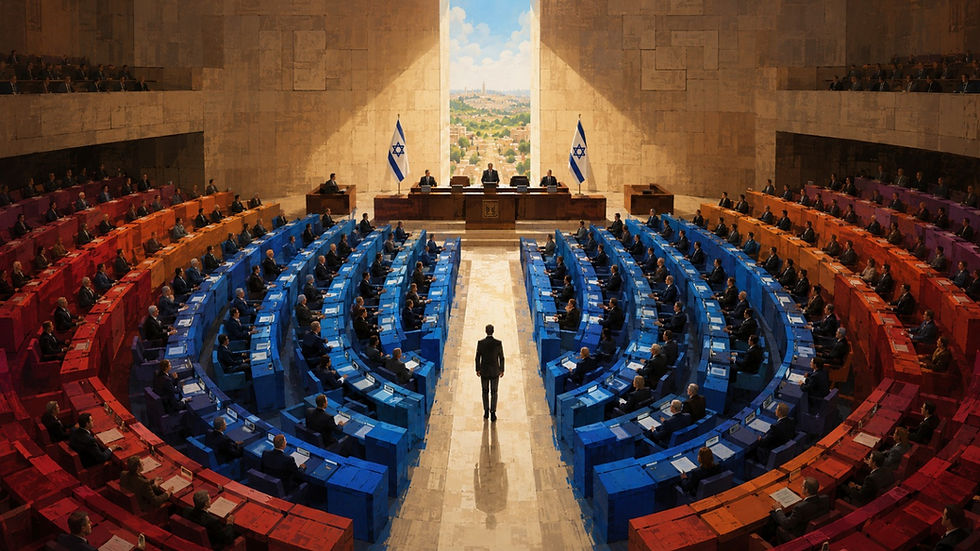
Instead of acting as a sovereign authority committed to the national interest, the government has turned identity politics into its operating model. When the leadership itself abandons the ethos of state responsibility, normalizes mass draft evasion, and empowers extremist forces that dismantle the Israeli social contract from within, it forsakes the Zionist majority that serves, works, and sustains the country.
This frustration has produced two opposing responses:
Radical opposition as an end in itself. At times, this spills over into disruption of public order, calls for military refusal, civil disobedience, and road blockages. This is a dangerous path because it is a recipe for chaos and disintegration. It also drives many Israelis back into tribal and partisan politics.
An inflation of centrist parties selling illusions of “healing governments” and “broad agreements,” without a distinctive political agenda. At best, they pursue self-evident goals with righteous indignation (who after all, opposes lowering the cost of living?). This is a paralyzing and anti-leadership approach that merely perpetuates the underlying problems. Never have so many Israelis been so confused by so many parties offering different shades of gray.
Israel needs radical change and a vital, functioning political system as it confronts a perfect storm of economic, technological, diplomatic, and security challenges. Entrenchment in identity politics is a destructive luxury that Israel can no longer afford. Disagreement, so long as it is conducted according to commonly accepted rules, is the lifeblood of democracy and is essential to its functioning and adaptability. Rather than “healing governments,” we need a vital, Zionist, Jewish and democratic Israel capable of making difficult decisions.
The yearning for sanity must be channeled into the construction of an organized political force that will establish a new civic framework, one capable of earning legitimacy and trust across the political spectrum. The goal is not to build a consensus around a particular political agenda, but to restore vitality and substance to Israeli politics—and, as a result, its capacity for innovation, adaptation, and pragmatism.
The political expression of this approach should be a New-Mamlachti* bloc: a group of Zionist members of Knesset from both the coalition and the opposition who cooperate on an ad hoc basis to veto sectoral extortion and narrowly sectarian legislation. Early signs of such a bloc emerged around the conscription law, when draft evasion during wartime led elected representatives from across the political spectrum to draw a red line.
This Zionist alliance should leave the door open to Arab and Haredi citizens, provided that they accept the rules of the game. They would not be required to abandon their identities, but rather to participate in a form of “functional partnership”: integration into employment, appropriately tailored civilian or national service, and the rejection of radicalism and ultranationalism.
A distinction should be made between unconditional fundamental civil rights—such as security, healthcare, freedom of movement, and the right to vote—and communal privileges, such as funding for specialized educational institutions or housing benefits, which should be linked to the community’s level of responsibility, integration, and contribution.
Instead, parties in the political center and on the right compete over who can reject Mansour Abbas more decisively, while on the left and in the center the rejection of the Haredim is categorical. This represents a missed opportunity to develop a civic model capable of generating stability.
The choice facing Israel is not between right and left, but between awakening and collapse. The time for vague language has passed; action is now required. The demand placed on parties seeking the public’s trust must be clear: present a bold and distinctive political agenda, and do not conceal your vision behind empty slogans of “healing.” At the same time, publicly declare your commitment to the principles of a new Mamlactiot even before voters go to the polls. * In the Israeli context, Mamlachti refers to a form of statism that places the state, its institutions, and the common national interest above partisan, sectoral, or personal interests. It implies responsibility, restraint, respect for democratic rules, and a commitment to serving the public as a whole.


Comments